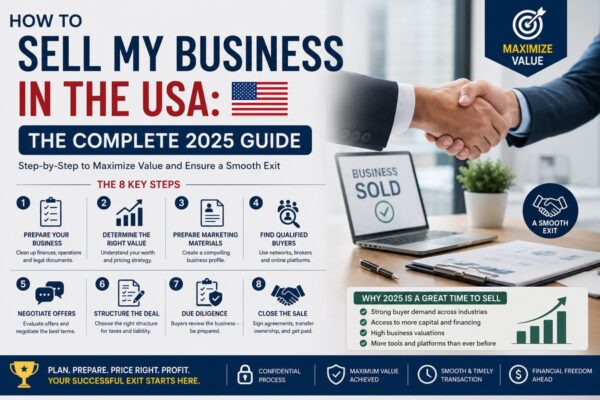


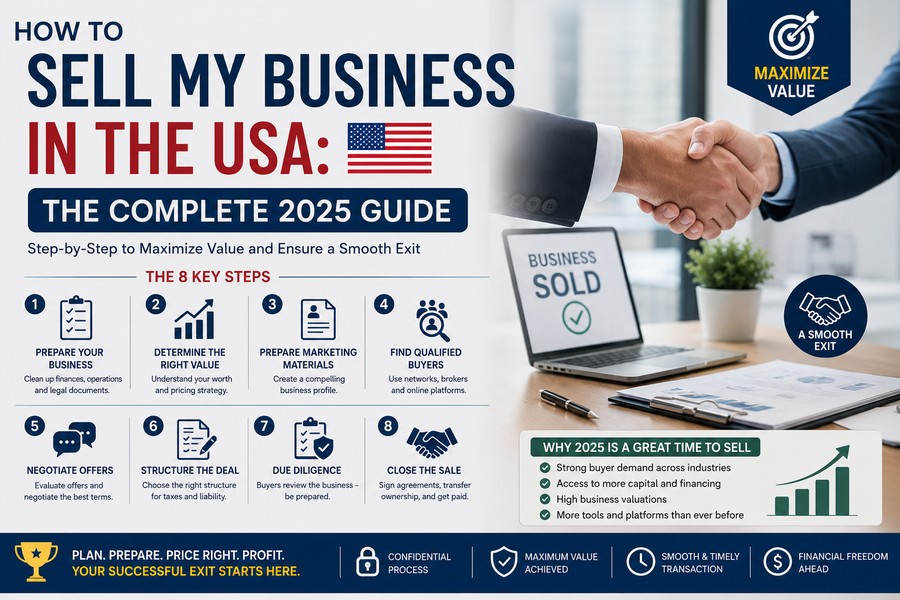
Quick Answer
To sell a business in the USA, you need to determine your business valuation, prepare financial documents, find a qualified business broker or M&A advisor, market to qualified buyers, negotiate terms, conduct due diligence, and close the deal. The process typically takes 6–12 months and requires legal, financial, and tax planning. Most small businesses sell for 2–4x their annual earnings (SDE or EBITDA).
Key Facts Table
| Factor | Details |
|---|---|
| Average time to sell a business | 6–12 months |
| Typical valuation multiple (small biz) | 2–4x SDE or EBITDA |
| Typical valuation multiple (mid-market) | 4–8x EBITDA |
| Business broker commission | 8–12% (Lehman Formula for larger deals) |
| Percentage of listed businesses that sell | ~20–30% (per IBBA data) |
| Most active buyer types | Strategic buyers, private equity, individuals |
| Top transaction platform | BizBuySell, Flippa (online), IBBA brokers |
| Capital gains tax rate (federal, long-term) | 15–20% depending on income bracket |
| Due diligence window | 30–90 days |
| Escrow/closing timeline | 30–60 days after offer acceptance |
Introduction
Deciding to sell your business is one of the biggest financial decisions you will ever make. Whether you’ve built a local restaurant from scratch, grown a regional manufacturing company, or scaled an e-commerce brand, the process of exiting your business in the United States involves dozens of moving parts — from valuation and marketing to legal contracts and tax planning.
This guide walks you through every major stage of selling a business in the USA, from the moment you first ask “how much is my business worth?” to the day you hand over the keys. It covers strategies used by experienced business brokers, M&A advisors, and successful sellers across industries.
Why Business Owners Sell: Common Motivations
Understanding why you’re selling shapes every decision you make during the process. Common reasons include:
- Retirement: The most common reason — owners ready to step back after decades of work.
- Burnout or health issues: Personal circumstances that make continued ownership untenable.
- Partnership disputes: Co-owners disagreeing on direction or exit timing.
- Growth capital needs: Owner wants to cash out equity to fund a new venture.
- Strategic opportunity: A competitor or industry giant makes an unsolicited offer.
- Market timing: The industry is peaking and the seller wants to exit at high value.
Knowing your motivation helps you set realistic timelines, communicate clearly with buyers, and stay committed through challenging negotiations.
Step 1: Determine Your Business Valuation
What Is a Business Worth?
A business valuation is the process of calculating the economic value of a business or ownership interest. In the USA, small businesses are most commonly valued using the Seller’s Discretionary Earnings (SDE) method, while mid-market and larger companies use EBITDA (Earnings Before Interest, Taxes, Depreciation, and Amortization) multiples.
SDE Formula:
Net Profit + Owner’s Salary + Non-cash expenses + One-time expenses = SDE
Common Valuation Methods:
| Method | Best For | How It Works |
|---|---|---|
| SDE Multiple | Small businesses (<$2M revenue) | SDE × 2–4x multiple |
| EBITDA Multiple | Mid-market ($2M–$50M revenue) | EBITDA × 4–8x |
| Asset-Based | Asset-heavy or distressed biz | Fair market value of assets |
| Revenue Multiple | SaaS, media, high-growth | Revenue × 0.5–3x |
| Discounted Cash Flow (DCF) | Established cash-flow businesses | NPV of future earnings |
Factors That Increase Business Value
- Recurring revenue streams (subscriptions, contracts)
- Strong management team that doesn’t depend on the owner
- Documented standard operating procedures (SOPs)
- Diversified customer base (no one customer >15% of revenue)
- Consistent 3–5 year growth trend
- Proprietary technology, patents, or brand recognition
- Clean, audited financial statements
Getting a Professional Valuation
Hire a Certified Business Appraiser (CBA) from the American Society of Appraisers (ASA) or a Certified Valuation Analyst (CVA) from NACVA. Professional appraisals cost $3,000–$10,000 but are critical for accurate pricing and buyer credibility.
Step 2: Prepare Your Business for Sale
The Importance of “Sale Readiness”
Most business brokers recommend spending 12–24 months preparing your business before listing it. Preparation can significantly increase sale price and reduce time on market.
Financial Documentation Checklist
Buyers and their lenders will require:
- 3 years of federal tax returns (business and personal)
- 3 years of Profit & Loss statements
- Current balance sheet
- Accounts receivable/payable aging reports
- Equipment list and condition reports
- Lease agreements (real estate and equipment)
- Customer and supplier contracts
- Employee records and org chart
Operational Cleanup
- Resolve pending litigation, tax liens, or compliance issues
- Renew expiring licenses and permits
- Update all business registrations with state authorities
- Document all key processes so the business can run without you
Step 3: Choose How to Sell
Option A: Business Broker
A business broker acts as an intermediary between buyers and sellers for businesses typically valued under $5 million. Brokers are licensed in most states and registered with the International Business Brokers Association (IBBA).
Pros: Industry expertise, buyer network, marketing resources, handles negotiations Cons: Commission of 8–12%, less control over buyer outreach
Option B: M&A Advisor / Investment Banker
For businesses valued above $5 million, Mergers & Acquisitions (M&A) advisors or boutique investment bankers are the right choice. They run structured sale processes (often competitive auctions) to maximize value.
Pros: Expert negotiators, access to private equity and strategic buyers, often achieve higher multiples Cons: Higher fees (5–8% plus retainers), best suited for larger transactions
Option C: Sell It Yourself (FSBO)
Some owners choose to sell without a broker using platforms like BizBuySell, BizQuest, or LoopNet (for commercial real estate).
Pros: No broker commission, direct control Cons: Time-intensive, fewer qualified buyers, higher risk of confidentiality breaches
Option D: Sell to Employees (ESOP)
An Employee Stock Ownership Plan (ESOP) allows employees to purchase the business over time. The IRS provides significant tax advantages for ESOP sales. This is regulated by the U.S. Department of Labor under ERISA guidelines.
Step 4: Market Your Business Confidentially
Protecting Confidentiality
Revealing that your business is for sale too early can alarm employees, suppliers, and customers. Effective confidentiality measures include:
- List under a blind profile (no business name or exact location disclosed)
- Require all buyers to sign a Non-Disclosure Agreement (NDA) before receiving details
- Use a broker to screen buyers before sharing the Confidential Information Memorandum (CIM)
The Confidential Information Memorandum (CIM)
Also called an Offering Memorandum, this 20–50 page document includes:
- Business overview and history
- Products/services description
- Financial summaries and projections
- Market and competitive analysis
- Management team overview
- Reason for sale
Where Buyers Come From
- Business broker networks (BizBuySell, IBBA)
- Private equity firms searching for acquisitions
- Strategic buyers (competitors, suppliers, adjacent businesses)
- Individual buyers seeking to own a business
- Family offices
Step 5: Qualify Buyers and Negotiate Offers
Buyer Qualification Criteria
Not every interested party is a genuine buyer. Screen prospects for:
- Financial capability: Proof of funds or pre-approval letter
- Relevant experience: Do they have industry knowledge?
- Motivation: Are they serious, or just “tire kicking”?
- Timeline: Are their goals aligned with yours?
Understanding the Letter of Intent (LOI)
A Letter of Intent (LOI) is a non-binding document that outlines the key deal terms including:
- Purchase price and payment structure
- Deal structure (asset sale vs. stock sale)
- Exclusivity period (typically 30–90 days)
- Due diligence conditions
- Earnout provisions (if any)
Asset Sale vs. Stock Sale
| Factor | Asset Sale | Stock Sale |
|---|---|---|
| What transfers | Selected assets & liabilities | Entire legal entity |
| Buyer preference | Preferred (less risk) | Less preferred |
| Seller preference | Less preferred (higher taxes) | Preferred (lower taxes) |
| Tax treatment | Ordinary income + capital gains | Capital gains only |
| Common for | Small businesses | Larger businesses, C-corps |
Step 6: Due Diligence
What Is Due Diligence?
Due diligence is the buyer’s formal investigation of the business before closing. It typically lasts 30–90 days and covers financial, legal, operational, and HR areas.
Common Due Diligence Requests
- Verification of all financial statements
- Customer concentration analysis
- Review of all contracts (leases, supplier agreements, customer contracts)
- IP and trademark verification
- Employment agreements and benefit plans
- Pending or historical litigation review
- Environmental compliance (for manufacturing businesses)
Being organized and transparent during due diligence builds buyer confidence and reduces the risk of deal collapse.
Step 7: Close the Deal
The Purchase Agreement
The Asset Purchase Agreement (APA) or Stock Purchase Agreement (SPA) is the final binding contract drafted by business attorneys. It includes:
- Final purchase price and payment terms
- Representations and warranties
- Indemnification clauses
- Non-compete and non-solicitation agreements
- Transition assistance terms
Escrow and Closing
Funds are held in escrow (managed by a title company or escrow service) until all closing conditions are met. The average closing timeline after an accepted offer is 30–60 days.
Transition Period
Most buyers require 2–4 weeks of seller training as part of the deal. Some deals include a longer consulting arrangement lasting 3–12 months, especially for owner-dependent businesses.
Tax Considerations When Selling a Business in the USA
Federal Capital Gains Tax
If you’ve owned the business for more than one year, long-term capital gains tax rates apply:
- 0% for incomes up to $47,025 (single filers, 2024)
- 15% for incomes up to $518,900
- 20% above that threshold
Note: The Net Investment Income Tax (NIIT) of 3.8% may also apply to certain business sale proceeds. Consult a CPA or tax attorney.
Section 1202 Exclusion
If you own Qualified Small Business Stock (QSBS) under IRS Section 1202, you may be able to exclude up to $10 million (or 10x your cost basis) in capital gains from federal tax. Specific holding period and other requirements apply.
Installment Sales
Structuring the deal as an installment sale spreads tax liability over multiple years, reducing the annual tax burden. This is common when part of the purchase price is paid via seller financing.
Actionable Tips for Selling Your Business Successfully
- Start preparing 2 years before you plan to sell — clean financials and reduced owner-dependency dramatically increase value.
- Don’t set your price based on what you “need” — base it on market data and a professional appraisal.
- Hire a CPA with M&A experience to structure the transaction for tax efficiency.
- Use an experienced business attorney for contract drafting and review — never rely on generic templates.
- Keep running the business at full speed throughout the sale process. Declining performance kills deals.
- Screen buyers carefully — protect your confidential information and your employees.
- Have a post-sale plan — many sellers experience identity and financial shock after exiting. Plan your next chapter.
FAQ: Selling a Business in the USA
1. How long does it take to sell a business in the USA?
Most small to mid-size businesses take 6–12 months to sell from the time they’re listed. Highly profitable businesses with clean financials and strong systems sell faster. Distressed or overpriced businesses can remain on the market for 2+ years.
2. What is my business worth?
Your business is worth what a willing buyer will pay. Most small businesses sell for 2–4 times their annual SDE (Seller’s Discretionary Earnings). Get a professional business appraisal from a CVA or CBA to establish a defensible market value.
3. Do I need a business broker to sell my business?
You don’t legally need a broker, but research from the IBBA shows that broker-assisted sales achieve higher prices and close at higher rates. Brokers bring buyer networks, confidentiality management, and negotiation expertise.
4. What is an SBA loan and how does it affect my sale?
Many individual buyers use SBA 7(a) loans to finance small business acquisitions. These government-backed loans (up to $5 million) can make your business accessible to more buyers. However, SBA financing requires the business to meet specific eligibility criteria and adds 60–90 days to the closing timeline.
5. What percentage does a business broker charge?
Business brokers typically charge 8–12% of the sale price for businesses under $1 million. Larger transactions use the Lehman Formula (5% on the first million, decreasing on subsequent tranches). Some brokers charge a minimum fee of $10,000–$15,000 regardless of deal size.
6. What’s the difference between an asset sale and a stock sale?
In an asset sale, the buyer purchases specific business assets (equipment, inventory, customer lists, IP) while the seller retains the legal entity. In a stock sale, the buyer purchases the ownership shares of the company, inheriting all assets and liabilities. Most small business deals are structured as asset sales.
7. How do I maintain confidentiality when selling?
Work with a broker who uses blind listings, require NDAs from all buyers before sharing financials, and avoid telling employees, suppliers, or customers until the deal is nearly closed. Information leaks are one of the leading causes of failed business sales.
8. What taxes will I owe when I sell my business?
Tax liability depends on the deal structure, asset categories, and your ownership duration. Long-term capital gains rates (15–20% federally) typically apply to the bulk of the proceeds, but some asset classes (like inventory and equipment) may trigger ordinary income tax. Work with a CPA specializing in business transactions.
9. What is an earnout in a business sale?
An earnout is a contingent payment structure where a portion of the purchase price is paid after closing based on the business achieving agreed-upon performance targets (e.g., revenue or EBITDA milestones). Earnouts reduce upfront risk for buyers but create post-sale risk for sellers.
10. What happens if no one buys my business?
If a business fails to sell, the owner has several options: relisting at a lower price, restructuring the business to improve value, pursuing a merger, closing and liquidating assets, or transitioning ownership to family members or employees via an ESOP. Working with an experienced broker upfront reduces the risk of an unsuccessful sale.
Key Takeaways
- Valuation is the foundation: Understand your SDE or EBITDA multiple before you set a price.
- Preparation takes 12–24 months: Clean financials, documented processes, and reduced owner-dependency dramatically boost value and sale speed.
- Confidentiality is critical: Use NDAs and blind listings to protect your business throughout the process.
- Professional advisors matter: Business broker, M&A attorney, CPA with transaction experience — invest in the right team.
- Tax planning cannot be an afterthought: Structure your deal early to minimize federal and state tax exposure.
- Only ~20–30% of listed businesses sell — pricing correctly and being sale-ready dramatically improves your odds.
Conclusion and Practical Recommendations
Selling your business in the USA is a rewarding but complex process that requires careful planning, professional guidance, and realistic expectations. The most successful exits share a common foundation: years of preparation, clean and verifiable financials, and a team of experienced advisors.
Practical steps to take today:
- Request a free business valuation estimate from a IBBA-member broker.
- Pull your last 3 years of tax returns and profit & loss statements.
- Identify and address any known red flags (customer concentration, owner-dependency, outdated equipment).
- Consult a CPA to model your after-tax proceeds under different deal structures.
- Research business brokers in your industry and region — and interview at least three.
Whether your exit is 6 months or 3 years away, starting the conversation with a qualified business broker or M&A advisor today is the most important step you can take toward a successful, profitable sale.